One thing you do a lot as an aspiring anything is apply to stuff. Residencies, fellowships, workshops. Most ask you for a script, a draft, a proposal, a body of work. Some concentrate their energy on a hyperproductive week or two, others have a longer timeline intended to give you space to breathe and stall out and restart.
Late last year I applied for the Moving Arts MADLab, where all you give them is a pitch—a paragraph or two that describes what you’re hoping to write. In return they give you two cold private readings, a workshop, and a public semi-staged reading over the course of ten months. The prompt was “LA Stories” and I was startled to realize, I had one.
It wasn’t until I had set my course for Los Angeles that I learned my great-grandparents had also spent some time here. In the 1920s, when they were in their 30s, just like me. I conceived of a play that would let me discover something about their lives here, while hoping to establish my own. I had a stack of family research, some old postcards with addresses, and a library I’d build during years of work on what I thought would be my second book—something about the Cherokee Diaspora, the prevalence of Wanna-Bes, the history you should have gotten in elementary school, and a recipe for reconnection that all the displaced young people could consult.
It turns out, like Carl Sagan said, if you wish to make an apple pie from scratch, you must first invent the universe. When I tried to write that Cherokee Diaspora book, I kept having to dip back four hundred years in the past to tell the story of this one family. In a work of narrative nonfiction, that’s a big ask. But on stage? All I had to do was put a contemporary character, Jay, within five feet of a historical character, Wenona, and voila, the past and future were colliding and I didn’t even need to explain why or how.
Well. Some people asked me to. But I refused. Cherokee storytelling isn’t linear. Southern storytelling isn’t linear. My project, which I called Embers Borne West, could bounce between the 1920s, the 1890s, and an ineffable space outside time where Jay could talk to anybody they liked.
Another irritating writerly cliche, that a play (or a book or an essay) teaches you how to write it. When I got stuck in my preferred mode of narrative, prolonged exposition, Embers would demand I activate the historical document I was trying to describe. I didn’t just tell the audience that my great-great-uncle Isaac appeared before a commission to change his enrollment from Cherokee to Choctaw, I put commissioners onstage like a panel of interrogation. And then I threw Jay in front of one as well.
While I was writing, I realized this wasn’t just one play, this was the first step in a trio of plays. If you wish to make an apple pie from scratch, you must first invent the universe. I was going to invent this dang universe. I got together with my cohort of MADLab writers and we met every week via zoom to share pages and check in. We took notes at the cold reads, and debriefed after each workshops, and gradually our plays materialized, page by page.
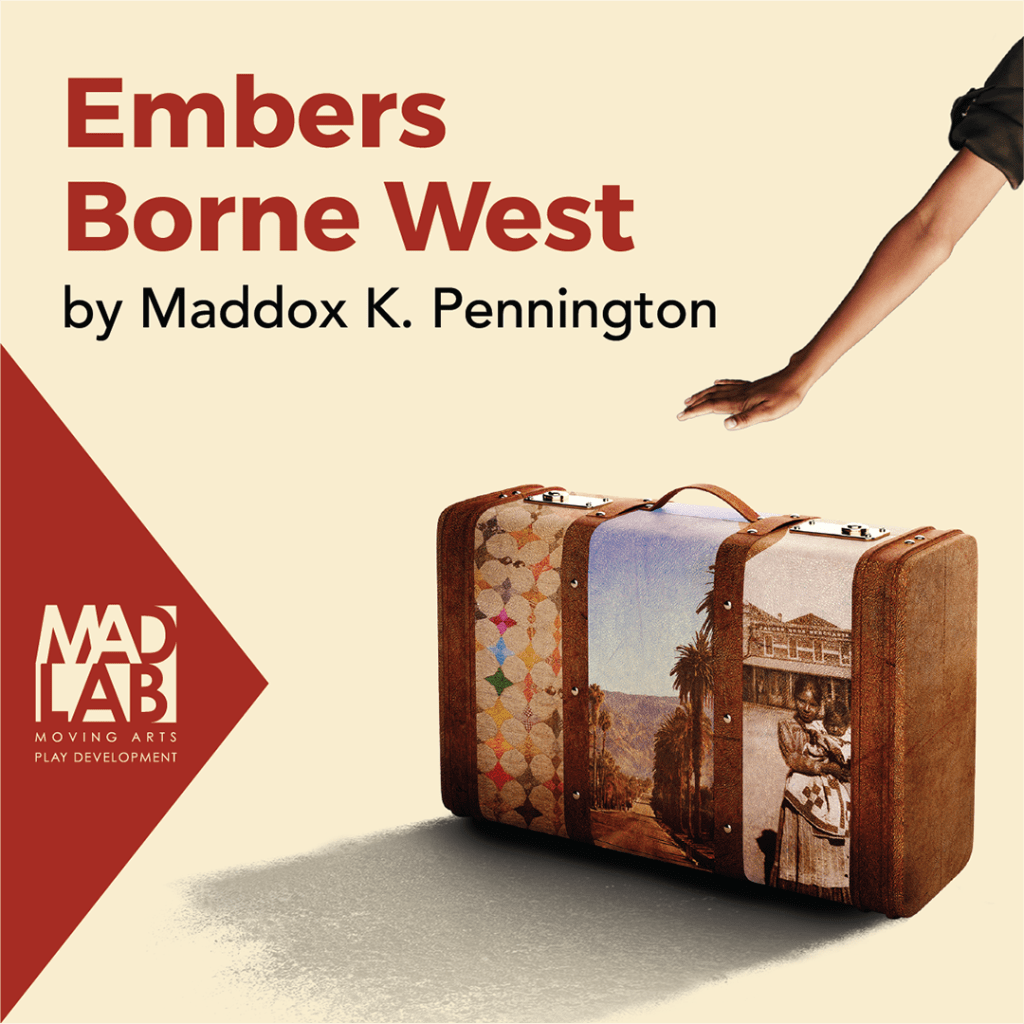
Embers Borne West is the story of Jay’s efforts to reconnect with their ancestors in Los Angeles, where they’re both out of place, in hopes of answering familiar questions about assimilation, migration, and belonging. Its first public reading was performed at the Moving Arts Theatre in Atwater, directed by Sabina Zuniga Varela. It really, really felt like something.
The second play in the cycle, Central Standard Time, finds Jay back in Oklahoma, rooted in the reality of living among people whose present is not as welcoming as the fictional past they invented for themselves and his great-grandparents. I completed a draft in a single weekend, like a dare, to submit to the Autry’s Native Voices festival, where you’ll be able to hear a version of it in a workshop reading this June!
The final play, Back East, doesn’t exist yet. I hope to develop it this summer. It’ll catch up with Jay and some otherworldly visitors in the waiting room of a hospital so everybody can finally hash out those lingering unknowns amidst the never-ending circle of life and death around them.
 Maddox K. Pennington
Leave a comment